The Artist as a Dreamer Consenting to Dream of the Actual World
Art as Catalysts for Change, Part 2 of 2
Title is a quote from George Santayana.
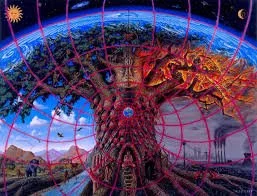
Image is entitled '“Gaia” by Alex Grey.
Some artists have served as prophets, ahead of their time only in that they see the present so clearly. It is in this way that, as the art critic Robert Hughes wrote, “… the truly significant work of art is the one that prepares the future…” In Art and Physics, Leonard Shlain writes, “Repeatedly throughout history, the artist introduces symbols and icons that in retrospect prove to have been an avante-garde for the thought patterns of a scientific age not yet born.”[i]
So, who is seeing clearly today? Who among the artists is not merely repeating old tropes or the newest fad of platitudes? Who is showing us forward with a biospheric language? As Alex Grey asked, “What mythology are our artworks communicating?" In answer, he writes, “The mythology that CoSM [his gallery and organization] is promoting is that we are on the cusp of the emergence of a planetary civilization and that world-wide there is a Love Tribe who recognizes that the human relationship with nature is sacred and needs healing.”
Grey’s large canvas painting entitled Gaia depicts two possibilities of humanity’s relationship with nature, one of destruction and suffering for all, and one depicting harmony and a healthy Earth.
We can all serve in our own way, of course. Asher Jay, for instance, is an environmentalist and fashion designer, who—after a Paul on the Road to Damascus kind of epiphany—turned artist and advocate for Earth’s living creatures. Her passion and artistic creativity have inspired students, businessmen, politicians, and environmentalists to action and introduced them to the multi-intelligent depths of a biospheric consciousness.
Then there is David Hykes, a visionary composer, musician, and meditation teacher who pioneered “Harmonic Chanting” and the Harmonic Presence work—a synthesis of music and contemplative practices woven into a unified approach for harmonizing the mind, body, and our relationship with all beings. For forty-five years, David has been bridging cultures and disciplines, collaborating with musicians around the globe and guiding music and meditation retreats in many countries around the world, and serving as the contemplative mentor-in-residence at Pommereau, a retreat and seminar center southwest of Paris, France.
David’s artistic mission reaches beyond “authentic self-expression” to being a vehicle “for spiritual experience.” “In other words,” he says, “not Art for Art’s sake, but Art for the sake of the sacred,” helping others to cultivate the deepest fundamentals of being—compassion, sensitive listening, good will and attentive accompaniment in service to others.
There are others, of course. But, of the many who call themselves artists, few are such prophets. Only a very few speak to the culture of collapse, as the philosopher Fredrik Bender called it, awakening us to our dominant paradigm, to societies that are exceedingly exploitive of the environment, of people, and of all beings. Few are introducing us to a biospheric language, to a way of thinking, speaking, and acting that is harmonious with the rest of the Earth.
Most artists are caught up in the same paradigm of consumption and ego gratification as the rest of us. They sing songs of lust and the loss of lovers, as they have been doing for the centuries since at least the 13th century troubadours and trobairitz; they paint and write and act and film their individual visions, often hoping for patrons that will make them moneyed and recognized. Nothing wrong with that. Artists must make a living, too.
The creations of artists can often serve—unintentionally for the most part—as propaganda for the status quo, sometimes simply by contributing to the din of noise and sheer volume of information through which one must sift to find the voice of the radical and the prophet. At worst, the artist will sell their soul to the dominant paradigm, becoming its mouthpiece, peddling brainworms and catchy tunes to which we all sing along. Anatoly Lunacharsky, Lenin’s Commissar of Education wrote: “Art is a powerful means of infecting those around us with ideas, feelings and moods. Agitation and propaganda acquire particular acuity and effectiveness when they are clothed in the attractive and mighty forms of art.”[ii]
In The Shock of the New, the art critic Robert Hughs wrote,
“The only moral of this, apart from the familiar fact that artists tend to work for whoever pays them, is that modernist styles were value-free and could serve almost any ideological interest. This was equally true of that dictator’s delight, neoclassism, the house style of Hitler and Stalin… Today, the idea [that art can morally influence the world] has largely been dismissed, as it must be in a mass media society where art’s principal social role is to be investment capital, or, in the simplest way, bullion. We still have political art, but we have no effective political art. An artist must be famous to be heard, but as he acquires fame, so his work accumulates “value” and becomes, ipso facto, harmless. As far as today’s politics is concerned, most art aspires to the condition of Muzak. It provides the background hum for power… It is hard to think of any work of art of which one can say, This saved the life of one Jew, one Vietnamese, one Cambodian. Specific books, perhaps; but as far as one can tell, no paintings or sculptures”[iii]
I do not mean to disparage our beloved artist friends. Rather, my aim is to remind us that, like the rest of us, most artists are neither seers nor prophets. They will not serve as the catalysts for transformation our species so urgently needs. Like us, they are shaped (mostly unconsciously) by the dominant culture of consumption and environmental destruction. Their distinction lies in their talent for their chosen craft.
So then, is it really that artists are more sensitive and aware than the lot of us? Or is it more like this: as a category, artists are proportionally as aware and sensitive and clear about the world as any random group of people, and they are simply the ones who can give aesthetically fetching expression to their insights? It is a gift, this ability for beauty and attention, but we must remember that it can serve many masters.
Surely, art will continue to serve as a voice for enlightenment and liberation. We will need it as much as the other change agents, such as meditation, psychedelics, psychotherapy, and education. These forces of change are not mutually exclusive, of course. They inform and amplify each other. Together, they will likely continue to be part of our cultural toolkit. Ideally, they will become increasingly integrated into our society, serving as dynamic catalysts for human transformation, guiding us towards a more sophisticated and harmonious relationship with nature—with Earth, life, society, and ourselves.
[i] Shlain (1993/2001:21).
[ii] Quote in Hughes (1981:87).
[iii] Hughes (1981:99, 111).