
Why One Degree of Global Warming Inflicts So Much Damage
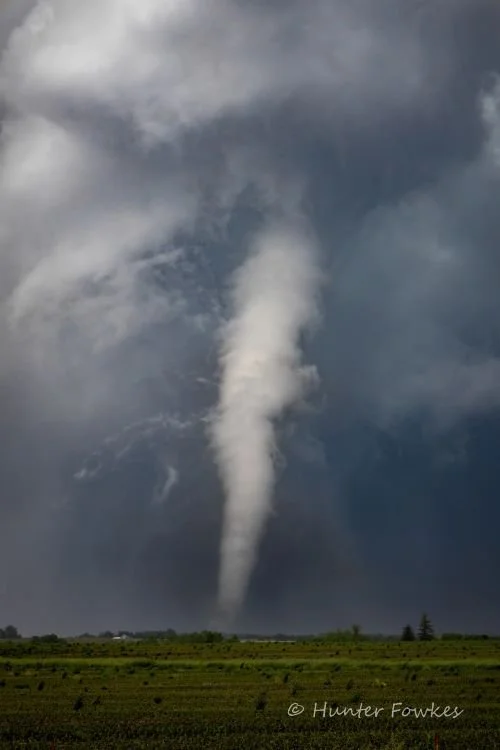
It’s Not Just the Temperature, It’s the Fever
According to the Intergovernmental Panel on Climate Change (IPCC), the Earth’s atmosphere has warmed about 1.1˚C (2˚F) since the years 1850-1900. That really does not really seem like much, does it? If the temperature were 63˚F on a comfortable October afternoon, would it really feel much different if it climbed to 65˚F? Likely not.
Yet, this seemingly minor increase is being blamed for a surge in catastrophic events – floods, droughts, heatwaves, crop losses, ecosystem disruptions, extreme weather events – as well as the migration of millions of climate refugees. And let’s not forget the melting glaciers and continental ice sheets and the rising sea levels. So, what gives? How can such a small temperature rise lead to such far-reaching consequences?
The Connection Between Temperature and Energy
It takes the least bit of logic and the simplest of math to make sense of it. First, the logic.
When we refer to a one degree rise in temperature, we mean that, on average, every location on Earth has become that much warmer all the time; day and night, across all seasons. And not just on the surface of the Earth, but for the entire lower seven miles of the atmosphere, known as the troposphere, where weather occurs.
That seemingly modest temperature shift, we will see, represents a massive influx of energy.
As you may know, temperature and energy are not the same. A glass of water and an entire ocean may have the same temperature, but the ocean holds vastly more energy. It is the energy in a physical system, such as the atmosphere, that tells you how much “work” can be done and therefore the magnitude of the possible consequences. Temperature cannot move wind, waves, and storms, but energy can.
The one-degree rise in temperature since 1850-1900 only hints at the true extent of the energy that the Earth has been absorbing.
A Tangent on Math Education
To show how much energy that one-degree rise of temperature represents, some simple mathematics will be useful. However, to understand the concepts it is not necessary that you read the following math/science section. The math is there, if you’re curious.
If you are not interested in the math, skip the next section and go directly to - “Civilization has Added Staggering Amounts of Energy into the Atmosphere.”
Quantifying Energy: The Atmosphere's Unseen Power
To give us a sense of how much energy a one-degree rise represents, we turn to a simple formula: q = mc∆T.
q is the heat energy measured in calories or joules that a system gains or loses. The system can be a rock, a lake, or the atmosphere, whatever you are studying.
m is the mass of that system. For practical purposes, you can think of mass and weight as being the same thing.[i] Because there is so much more water (more mass) in a lake than in a bucket of water, a one-degree rise in the lake is going to translate into a lot more energy than a one-degree rise in a bucket of water.
c is something call specific heat. Different substances absorb heat differently. Just think how hot a car’s metal skin gets in the summer sun and how cold in the winter. Metal’s low specific heat tells you that a little heat quickly raises its temperature. Water’s high specific heat tells you that it takes a lot more energy to raise its temperature.
∆T just means the change in temperature.
So, we’re going to use this equation q = mc∆T to give us a sense of the energy the atmosphere has acquired since the years 1850-1900.
Since we know the temperature change we’re considering (1.1˚C, because scientists use the metric system) and the specific heat of air (1004 J/kg·˚C), we need to find only the mass of the Earth’s atmosphere. The atmosphere’s mass is estimated to be about 5.10 x10¹⁸ kg. We will use only 80% of that mass, because it is the bottom layer of the atmosphere that is warming. This layer contains about 80 percent of the atmosphere’s molecules.
80% of 5.10 x10¹⁸ kg = 4.08 x 10¹⁸ kg.
By the way, 1018 is a million trillion or 1,000,000,000,000,000,000 – a very big number. The Earth is big, and we are very small.
So, the additional energy in the atmosphere associated with a 1.1˚C change =
q = mc∆T = (4.08 x 10¹⁸ kg)(1004 J/kg·˚C) (1.1˚C) = 4.5 x 10²¹ J.
1021 is clearly an enormous number – a billion trillion.
Civilization has Added Staggering Amounts of Energy into the Atmosphere
To repeat, the additional energy in the atmosphere associated with a mere 1.1˚C change = 4.5 billion trillion Joules, or about a million trillion Calories.
For comparison, the atomic bomb “Little Boy” that was dropped on Hiroshima in 1945 released 63 trillion joules of energy.[ii] This means that the energy added to the atmosphere represented by a 1.1˚C temperature rise equals the energy that would be released by 71 million Hiroshima-sized explosions. That’s about one atomic bomb for every hundred people on Earth.
While the energy released in hyper-energetic nuclear events is concentrated in specific locations, the energy absorbed by the atmosphere is spread across an enormous volume. Nonetheless, this diffuse energy powers storms, intensifies cyclones, and amplifies heatwaves, fueling a chaotic and unpredictable climate system.
We are trying to contemplate unimaginable amounts of energy interacting in unimaginably complex ways! What is simple to understand is this: the portion of the atmosphere where weather and climate occur carries far more energy than it did a mere hundred years ago.
How much energy? The energy that would be released by 71 million atomic bombs. This is about the same amount of energy as would be released by eleven million W76-1 thermonuclear bombs, which is about one thousand times more than the nuclear stockpile of all countries combined. (The W76 is being referenced as it is the most numerous in the U.S. arsenal and therefore the most representative in terms of power.)
It should not surprise us, then, when we witness – both in our lives and through the media – historic changes in weather events, especially extreme weather events, as well as shifts in climates across the planet, and the impacts of these on all the life forms sharing this planet with us.
The Domino Effect: From Climate to Civilization
Why does this matter to us? Because no matter how sophisticated our civilization, no matter how comfortable and entertaining it appears and how seemingly removed we are from the rest of nature, our survival always hangs on the knife’s edge of food security. And farming, the cornerstone of global food security, depends on predictable weather patterns. This is the very system with which we are tampering when we add hundreds of billions of tons of carbon dioxide (CO2) and methane (CH4) to the atmosphere.
Scientists expect that, without drastic change, Civilization’s carbon emissions will increase Earth’s atmosphere temperature another one to three degrees Celsius by century’s end; that is, the atmosphere will be holding yet another 65 to 200 million “Little Boys” worth of solar energy.
Facing the Future: Beyond Degrees of Warming
It is the vast amounts of energy involved, not the few degrees of temperature, that is truly frightening. This energy destabilizes weather systems, intensifies natural disasters, and threatens ecosystems and human life alike.
If we fail to address this issue, we risk jeopardizing not just weather patterns but the foundations of global civilization itself. Our choices today will determine whether humanity can adapt to or even overcome this unprecedented challenge.
[i] Mass is the amount of matter in an object, while weight is the gravitational force exerted on that object.
[ii] To estimate the energy released by “Big Boy,” I am using the work of Pittock et al, 1986): The energy released in the only two atomic bombs ever employed against a populace (15 kt TNT on Hiroshima and 21 kt TNT on Nagasaki) = 36 kt of TNT (Pittock et al., 1986) = 1.5 x10¹⁴ Joules. Simple math finds that 1 kt ≈ 4.17 x 10¹² J. So, 15kt x (4.17 x 1012J/kt) ≈ 63 x1012 J.